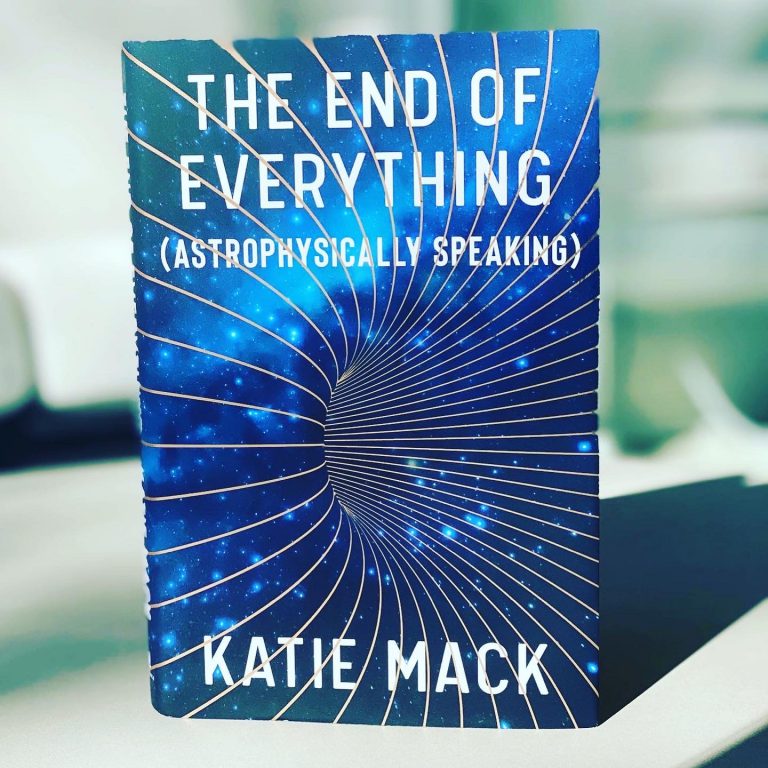
The End of Everything (Astrophysically Speaking)


- Form: Hardcover
- Page Count: 227
- Purchase Link
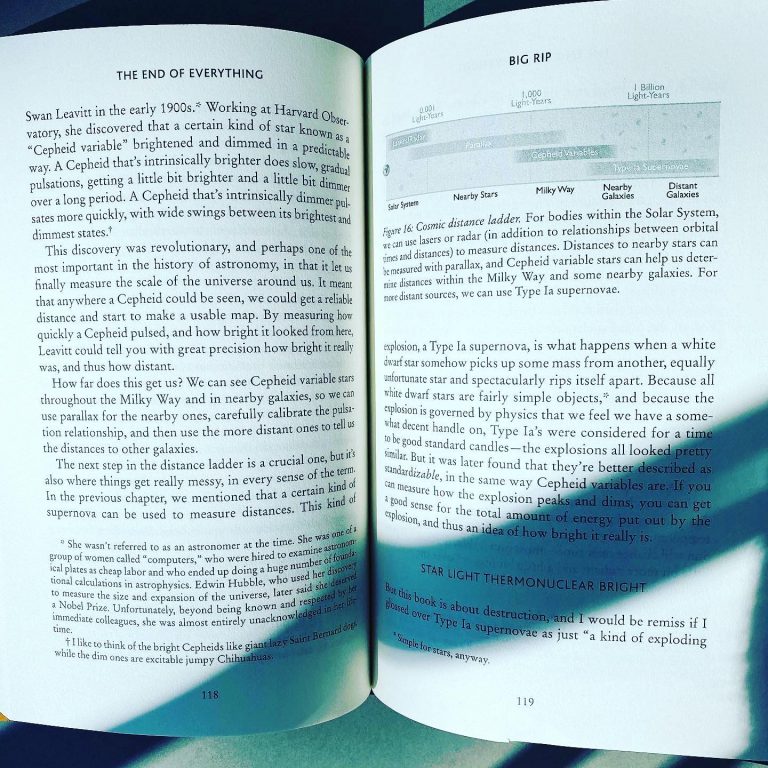
Extremely fun to read. Mack provides a very approachable summary of the latest and most bleeding edge work in theoretical astrophysics. The book is titled “The End of Everything” — and Mack certainly covers that topic, summarizing five possible scenarios that would spell the end of the universe (the Big Crunch, Heath Death, the Big Rip, and Vacuum Decay) — but she also provides a helpful summary of how we got here in the first place. As she writes, there is broad consensus that the universe had a “beginning”, but I had no idea how contentious the scientific debate has been on just this topic for hundreds (or thousands) of years.
What most struck me from reading this book was how variable the potential outcomes are when it comes to predicting the end of the universe (at least from our vantage point). One of the biggest culprits of this, unsurprisingly, is the (quasi) mystery of dark matter and its role as the protagonist in the saga of our universe.
The other element (also not too surprising) is the role of complexity science in all of this. Tiny deviations or changes in our understandings of the universe, as they are discovered, can so dramatically alter the scientific community’s resulting hypotheses about core issues that is causes us to re-write theory after theory and often start from scratch.
Mack also shows the reader a few wild card cases, almost all of which run diametrically counter to our own (or at least my own) logical basis of understanding, which themselves in turn change underlying assumptions. My favorite of these in the book is the fact that in many cases, cosmic objects (like planets, stars, ect.) appear larger the farther they are from the observer, which quite delights astrophysicists in many cases, but caused me to re-read the passage a few times in a row to make sure I wasn’t catching a typo. Unfortunately for me, I wasn’t. Just another example of how I remain (very) far on the periphery of understanding really any advanced theory in this space.