Technological Revolutions and Financial Capital



- Form: Paperback
- Page Count: 198
- Purchase Link
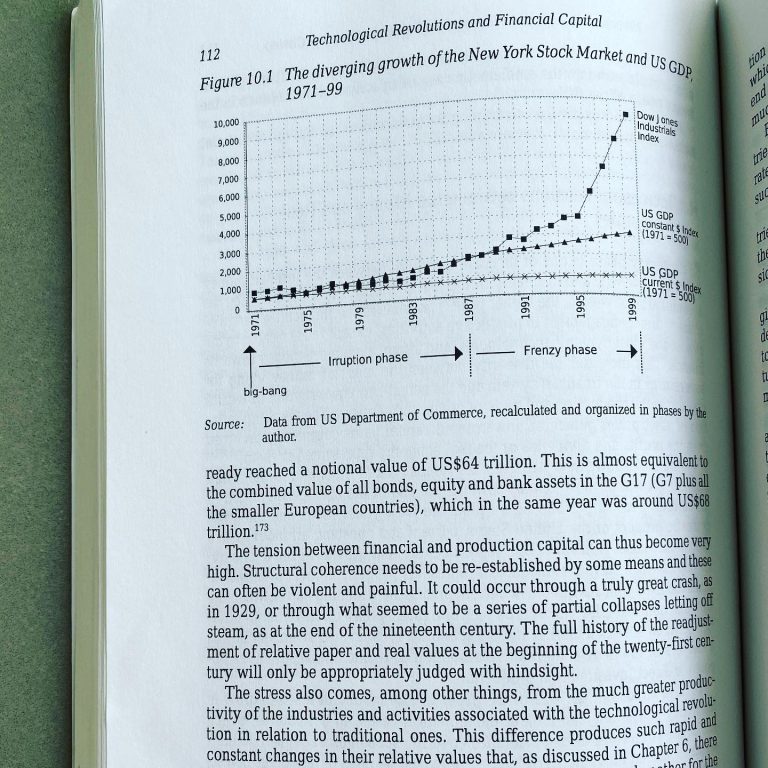
Wow. This was an incredibly instructive and important book. And of the longest and most challenging works I’ve read thus far that has such a small page count. Carlota Perez, a powerhouse Venezuelan economist, puts forth a fascinating model, beginning with case studies in the 18th century and extending to today, of how technological developments spur multi-decade revolutions in more or less systematic cycles, from the “Big Bang” moment of the discovery of groupings of new technological tools to the frenzy phase of their implementation, to a “wake-up” moment of overextension usually characterized as a economic recession or depression, to a synergy phase and maturity phase, before the start of the next technological revolution cycle.
There are so many implications of this book and Perez’s model, but two stand out to me most. The first is the relationship between “financial capital” and “production capital”; how the former dominates the early, speculative rise of a new technological paradigm, but inevitably overruns, creating a major disparity between paper wealth and real wealth — then, following a correction, how production capital comes into play during the synergy and maturation phase, getting in sync with financial capital, and allowing more of the economy to participate in growth.
The second is the more macro, temporal implications of the model. One is struck, reading in hindsight, about just how long each of these technological revolutions have taken place, and how, when one is experiencing them, it seems like one is experiencing an unprecedented precent phenomena that cannot, or could not have, been predicted by past trends. It beckons questions of free will and agency as well — are we capable of understanding the long arc of these trends when we are in the midst of them, and make decisions to alleviate them in the moment, and thus prevent the “predictable” recessions and depressions mid-cycle? Or are those permanent, unchanging and necessary components of the societal implementation of new technologies? Perez, for her part, is nuanced in her answer to this question (it is a “yes and no.”